
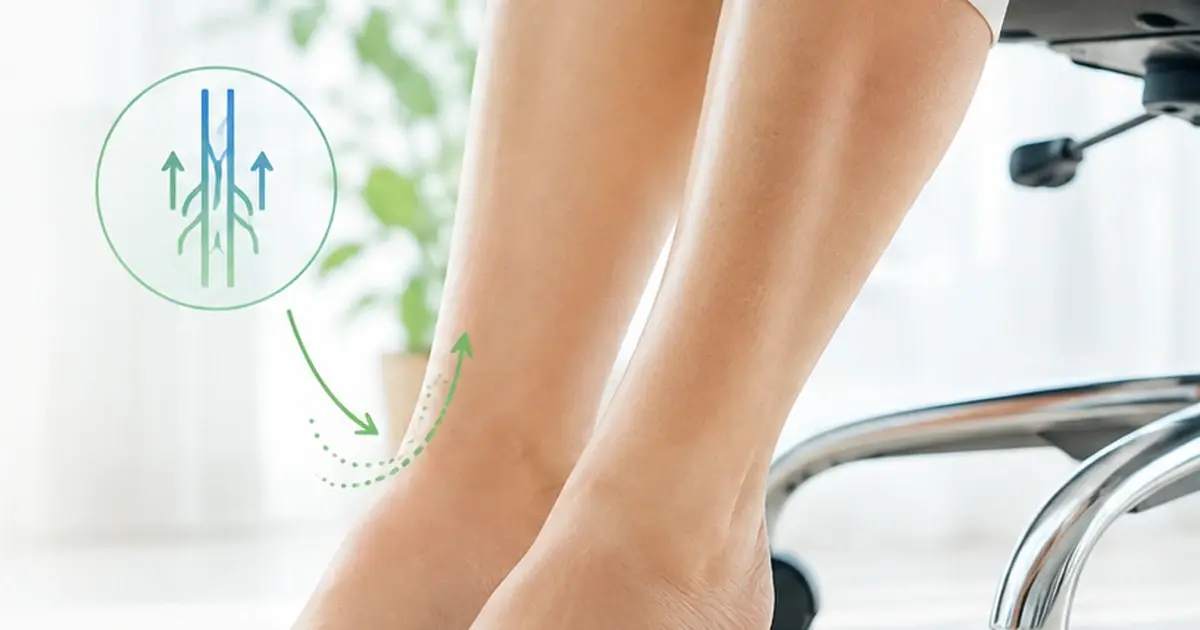
Why can sitting for hours make your ankles swell?
The lower legs work against gravity all day. When you walk, the calf muscles repeatedly contract and help move blood through the leg veins. During long periods of sitting, that muscle-pump activity drops.
The Mayo Clinic notes that prolonged sitting can contribute to mild edema, while its guidance on air travel explains that sitting with the feet down for a long time allows blood to pool in the leg veins and increases pressure inside those veins. That pressure can contribute to fluid moving from the bloodstream into surrounding tissues.
Gravity pulls downward
Fluid and blood naturally face more gravitational pressure in the lower legs when you are upright or seated.
Less calf movement
Walking activates the calf-muscle pump. Long sitting means less muscular assistance moving blood back upward.
More fluid in tissues
Higher pressure in the leg veins can make it easier for fluid to shift into the tissues around the ankles and feet.
Is ankle swelling after sitting a lymphatic problem?
Not necessarily. The lymphatic system helps collect excess fluid from tissues and return it to the bloodstream, so it is part of normal fluid balance. But ankle swelling has many possible mechanisms and causes.
True lymphedema refers to swelling related to impaired lymph drainage. That is different from assuming that common end-of-day ankle puffiness means the lymphatic system is “clogged.” In many people, sitting-related swelling is better understood as dependent edema or fluid pooling associated with gravity and reduced movement.
Common sitting-related pattern
Often develops gradually after hours in one position, may affect both ankles, and may improve after walking, changing position or elevating the legs.
Pattern that needs more attention
Sudden, severe, painful, unexplained, red, hot, or mainly one-sided swelling — especially with calf pain or systemic symptoms — deserves prompt evaluation.
What else can cause swollen ankles?
Prolonged sitting is only one possibility. The NHS and Mayo Clinic both list a broad range of causes of ankle, foot and leg edema. The table below is a practical way to think about them without diagnosing yourself from one symptom.
| Possible contributor | What it can look like | Why context matters |
|---|---|---|
| Long sitting or standing | Gradual swelling, often later in the day and often on both sides. | Movement and elevation may help, but persistent swelling still deserves attention. |
| Salt intake | Fluid retention can be more noticeable after salty meals in some people. | Diet is one factor, not a complete explanation for recurring edema. |
| Medicines | Some blood-pressure medicines, hormones, steroids and other drugs can contribute to edema. | Do not stop prescribed medication on your own; discuss suspected side effects with a clinician. |
| Pregnancy | Swelling of the feet and ankles can occur during pregnancy. | Pregnancy also has specific warning signs that require professional assessment. |
| Vein problems | Varicose veins or chronic venous insufficiency can cause pooling, heaviness and swelling. | Recurring symptoms may need evaluation of the veins and circulation. |
| Injury or infection | Swelling may be more localized and can occur with pain, redness, warmth or tenderness. | The presence of pain, heat, fever or skin changes can alter urgency. |
| Blood clot | DVT can cause sudden swelling and pain, commonly affecting one leg. | This needs prompt medical assessment because a clot can become dangerous. |
| Heart, kidney or liver conditions | Fluid retention may affect the legs and sometimes other parts of the body. | These causes require medical diagnosis and treatment of the underlying condition. |
What may help mild ankle swelling after sitting?
For uncomplicated swelling clearly associated with a long period in one position, the NHS recommends measures that focus on movement, positioning and avoiding prolonged immobility. These are general measures — not treatment for an unknown medical cause.
Get up and walk
Gentle walking activates the lower-leg muscles and can help improve blood flow after prolonged sitting.
Elevate your legs
When practical, place the legs on a chair or pillows so the swollen area is raised while you rest.
Break up long sitting
Avoid remaining in the same position for hours. Short movement breaks are a simple way to reduce uninterrupted immobility.
Avoid overly tight footwear
Comfortable shoes and clothing can prevent additional constriction around already swollen feet or ankles.
What about compression socks?
Compression garments are commonly used in some edema and venous conditions, but the right type and compression level depend on the person and the cause of swelling. If ankle swelling is recurring or you have circulation concerns, ask a healthcare professional whether compression is appropriate for you rather than treating it as a universal fix.
When should swollen ankles be medically evaluated?
Swelling that keeps returning, lasts, has no clear explanation, or comes with other symptoms deserves a professional assessment. The urgency rises when the swelling is sudden, painful, severe, red, hot, or concentrated on one side.
Seek urgent or emergency medical care when swelling is accompanied by:
- Shortness of breath or difficulty breathing.
- Chest pain, tightness or heaviness.
- Coughing up blood.
- Fainting, marked lightheadedness, confusion or severe weakness.
- Sudden one-sided leg swelling with calf pain or tenderness.
The NHS also advises prompt assessment when swelling is severe, painful, starts suddenly, is red or hot, occurs with fever, or affects someone with diabetes. The exact level of urgency depends on the full clinical picture.
Would lymphatic drainage help swollen ankles?
“Lymphatic drainage” can mean different things online. In clinical care, manual lymphatic drainage is a specialized gentle-massage technique used as part of lymphedema management for selected patients. It is not a generic treatment for every person whose ankles swell after sitting.
If your swelling is simply related to prolonged sitting, movement and elevation may be more relevant first steps. If you have diagnosed lymphedema or another condition affecting fluid drainage, treatment should be guided by a qualified professional who understands the underlying cause and any contraindications.
Where do “lymphatic support” supplements fit?
People searching for swollen ankles often encounter supplements marketed with phrases such as “lymphatic flow,” “fluid balance,” “natural drainage,” or “circulation support.” Those marketing terms should not be treated as proof that a supplement treats edema, venous disease, lymphedema, a blood clot, or any other medical cause of swelling.
A useful product review should separate the seller's positioning from evidence on the finished formula. If you are researching a specific supplement, check the actual ingredients, safety considerations, finished-product evidence, billing terms and refund policy rather than relying on the symptom match alone.

Researching Linfozen after seeing lymphatic-support claims?
Linfozen is a botanical dietary supplement marketed with lymphatic-flow, natural-drainage, fluid-balance and circulation language. Our independent review examines its current ingredients, pricing, purchase terms and evidence limitations.
Read the Independent Linfozen Review → Editorial link • The review contains disclosed affiliate links. NutraNova Health does not present Linfozen as a treatment for swelling.Frequently asked questions
Why do my ankles swell after sitting all day?
Long periods of sitting can reduce calf-muscle activity and increase pooling of blood in the leg veins. Together with gravity, this can contribute to fluid moving into tissues around the ankles and feet. Other causes are possible, so the pattern and associated symptoms matter.
Is ankle swelling after sitting always a lymphatic problem?
No. The lymphatic system participates in fluid balance, but prolonged sitting can cause dependent swelling through venous pooling and reduced movement. Medicines, pregnancy, vein problems, injury, infection, blood clots, and heart, kidney or liver conditions can also contribute.
Can walking help swollen ankles after sitting?
Gentle walking may help improve blood flow after prolonged sitting. The NHS also recommends elevating the swollen area and avoiding long periods in the same position when dealing with uncomplicated ankle, foot or leg swelling.
Why is one swollen ankle more concerning than two?
One-sided swelling can have many causes, including injury or infection, but sudden swelling in one leg with pain can also occur with deep vein thrombosis. That pattern deserves prompt medical evaluation rather than self-treatment.
Do lymphatic supplements treat swollen ankles?
A dietary supplement should not be used as a substitute for diagnosing the cause of swelling. Marketing language about lymphatic flow or fluid balance does not establish that a product treats edema, lymphedema, venous disease or other medical conditions.
Sources & editorial references
NutraNova Health used established medical references to verify the causes, self-care context and warning signs described on this page. These references provide general educational information and do not diagnose an individual reader.
Used for common causes of edema, prolonged sitting or standing, measures that may ease swelling and urgent warning signs.
Used for the definition of edema, causes related to prolonged sitting, medicines and underlying disease, plus DVT warning context.
Used to explain venous pooling, pressure in the leg veins and fluid movement during prolonged sitting.
Used for dependent edema context related to gravity and prolonged sitting or standing.

Valeria researches nutrition, dietary supplements and natural wellness topics with an emphasis on evidence, transparent information and realistic consumer expectations.